Inventory Management and PPE Procurement

Healthcare Operations & Resource Managementhealthcare operationsrobust optimization
Summary

Most inventory models address demand uncertainty but give limited attention to lead time uncertainty, particularly endogenous lead time uncertainty, and often ignore stockpile policies and large-scale disruptions. We propose a two-layer, demand-driven optimization framework that jointly models exogenous demand uncertainty and decision-dependent lead time uncertainty under partially backlogged demand. We developed a stochastic and robust framework that uses data-driven multiple uncertainty sets and a rolling horizon to control conservatism. We reformulate the resulting model into a tractable mixed-integer linear program and evaluate inventory policies using real hospital data (NYU Langone Health), demonstrating improved cost efficiency and system resilience.
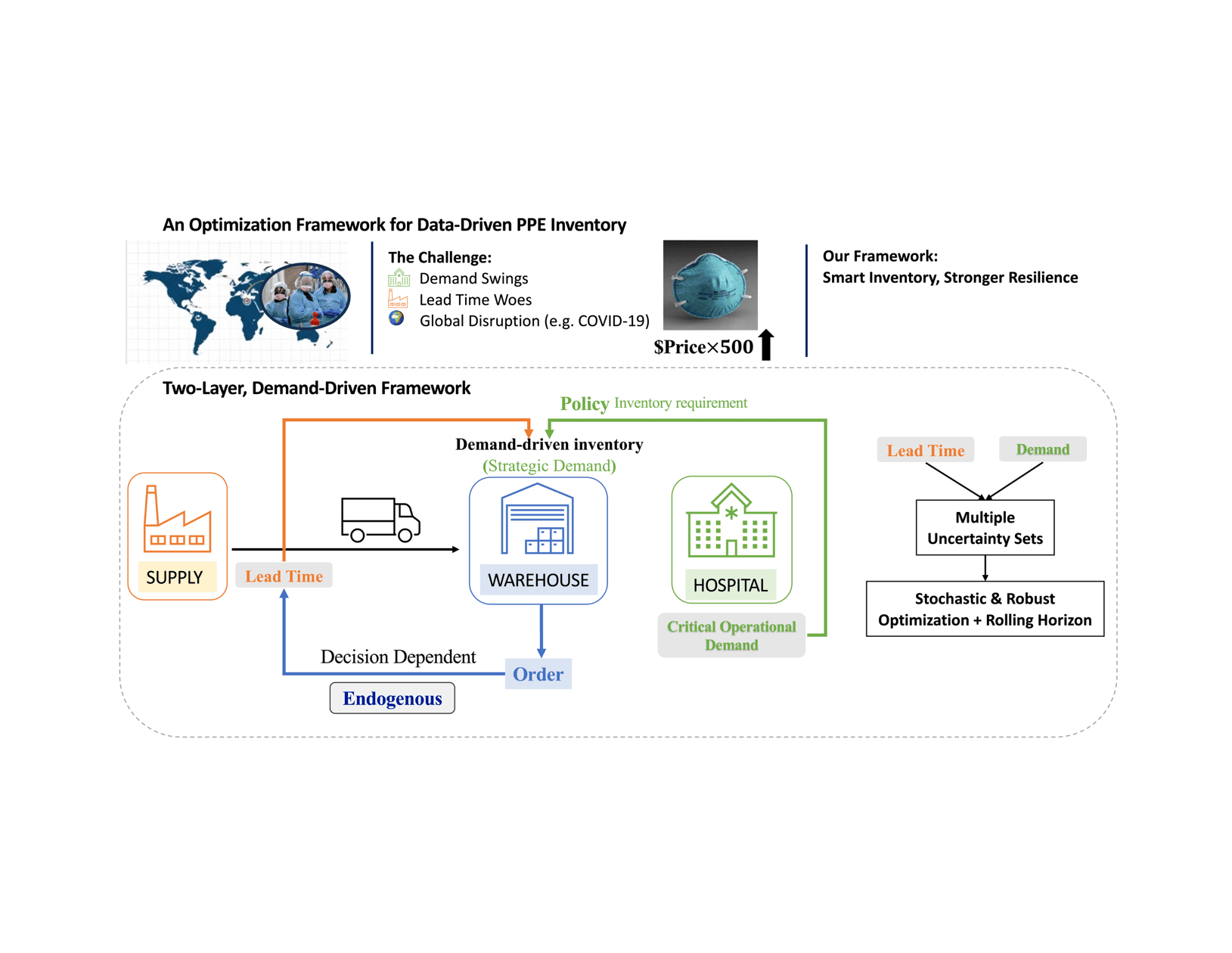
The framework adopts a two-layer, demand-driven structure that distinguishes between strategic inventory demand and critical operational demand in healthcare systems for PPE. It explicitly models both exogenous demand uncertainty and endogenous, decision-dependent lead time uncertainty using data-driven multiple uncertainty sets. A rolling-horizon stochastic through robust optimization approach is used to balance inventory cost, service performance, and system resilience under global PPE supply disruptions.