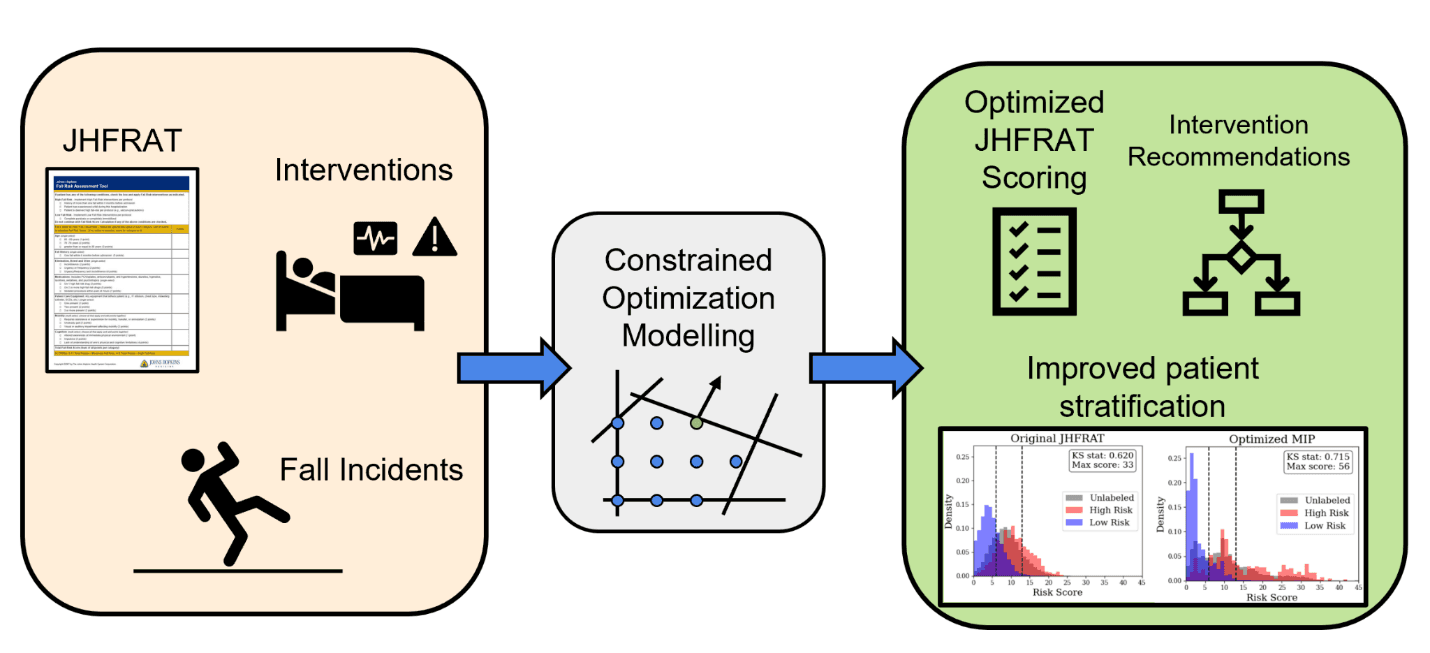
This project utilizes data-driven optimization and machine learning methods to improve the quality of inpatient fall risk assessment and decision-making. Our team has developed novel optimization models to increase the sensitivity and specificity of identifying patients at high risk for falls, while maintaining interpretable model structure using the Johns Hopkins Fall Risk Assessment Tool (JHFRAT) and additional electronic health record (EHR) data. The new models account for rarity of falls and uncertainty in true underlying risk due to risk-obscuring interventions. We are continuing to work on data-driven methods for understanding the relationships between EHR measures of risk, fall prevention interventions, and fall incidence in order to provide automated clinical decision support.
Publications
Optimizing Clinical Fall Risk Prediction: A Data-Driven Integration of EHR Variables with the Johns Hopkins Fall Risk Assessment Tool
Ganjkhanloo F, Springer E, Hoyer EH, Young DL, Ghobadi K
arXiv
Joint Score-Threshold Optimization for Interpretable Risk Assessment Under Partial Supervision
Ganjkhanloo F, Springer E, Hoyer EH, Young DL, Ghobadi K
arXiv
Falls in Hospitals: Challenging Traditional Risk Assessments With New Insights Into Patient Mobility
Hoyer EH, Young DL, Zhang C, Colantuoni E, Ghobadi K
Journal of Advanced Nursing
Association of Longitudinal Mobility Levels in the Hospital and Injurious Inpatient Falls
Hoyer EH, Young DL, Ke V, Zhang JY, Colantuoni E, Farley H, Dahbura A, Ghobadi K
American Journal of Physical Medicine & Rehabilitation,