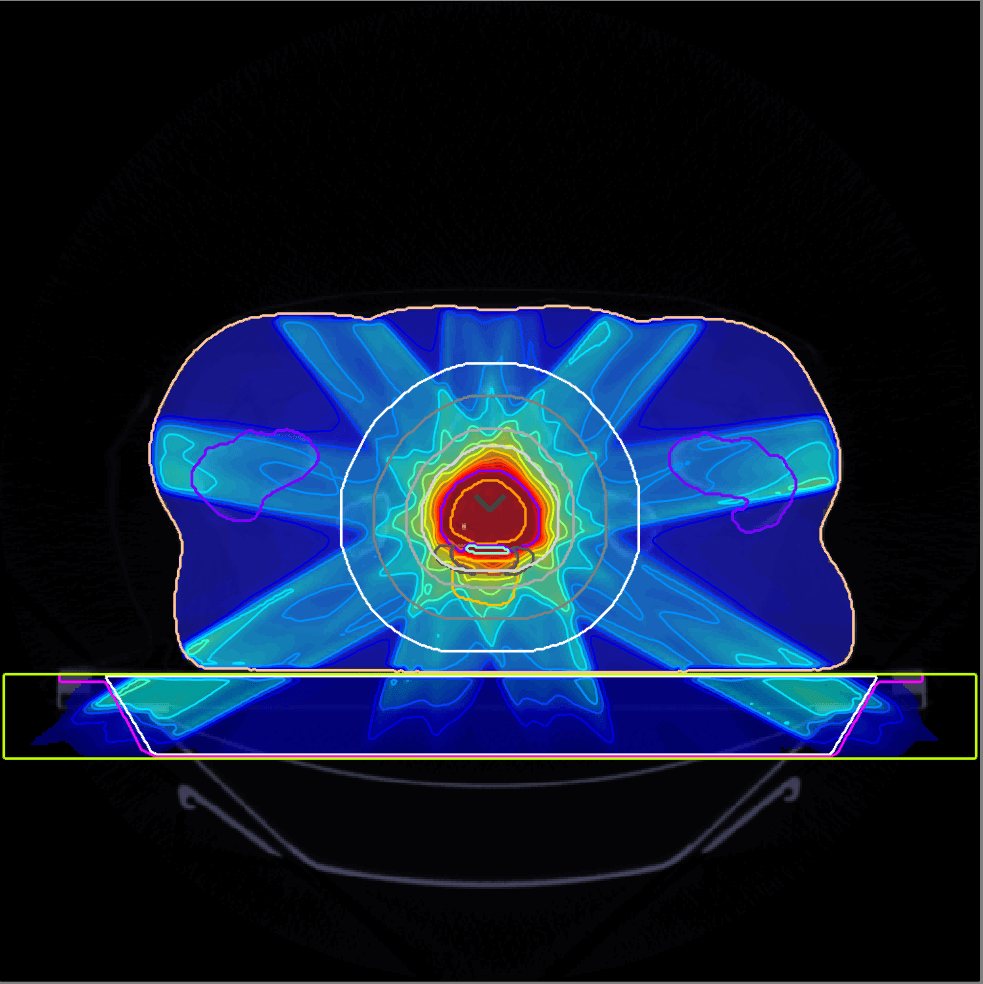
This project tackles a practical bottleneck in radiation therapy planning: even with modern planning software, clinicians often have to "tune" dose-volume limits for tumors and nearby organs through repeated trial-and-error, and small changes in those limits can unlock meaningfully better plans. The central idea is to use inverse optimization to learn, from existing clinically acceptable plans, what trade-offs are implicitly being made, then use that learned structure to systematically adjust a small number of key constraint parameters (especially for organs-at-risk) to search for improved, still-clinically-reasonable plans. Rather than treating constraints as fixed inputs, the method treats them as decision levers. It identifies where constraints are overly conservative or misaligned with the plan's true priorities, relaxes or tightens them in a controlled way, and explores the resulting trade-off surface to find plans that better spare healthy tissue without compromising target coverage. A key contribution is translating this concept into a practical, iterative workflow that can work alongside commercial planning systems (demonstrated with RayStation).
Publications
Improving Observed Decisions Quality using Inverse Optimization: A Radiation Therapy Treatment Planning Application
Ahmadi F, McNutt TR, Ghobadi K
arXiv preprint