Scheduling in Surgery and Homecare

Healthcare Operations & Resource Managementhealthcare operationsrobust optimization
Summary

We study healthcare scheduling across the patient care pathway, from surgery to post-discharge home care. The first project focuses on operating room scheduling with ward inpatient capacity constraints. Elective surgery decisions induce uncertainty in surgery durations and subsequent ward needs, measured by length of stay (LOS), across inpatient units. We develop a data-driven robust optimization framework that jointly coordinates operating room scheduling and downstream capacity planning under surgery duration and LOS uncertainty, leading to improved service levels and more efficient resource utilization.

A second arm of this project focuses on home-care scheduling, an alternative to inpatient and long-term institutional care that improves patient outcomes while reducing system costs. Patients discharged from hospitals and community clients compete for limited caregiver capacity. Home-care operations must manage time-window constraints, travel efficiency, and caregiver–client continuity in the presence of demand uncertainty and implementation delays. We propose a decomposition-based optimization framework that integrates long-term caregiver–client assignment with short-term scheduling decisions and captures uncertainty propagation over time using a Dynamic Bayesian Network (DBN) and Distributionally Robust Optimization (DRO).
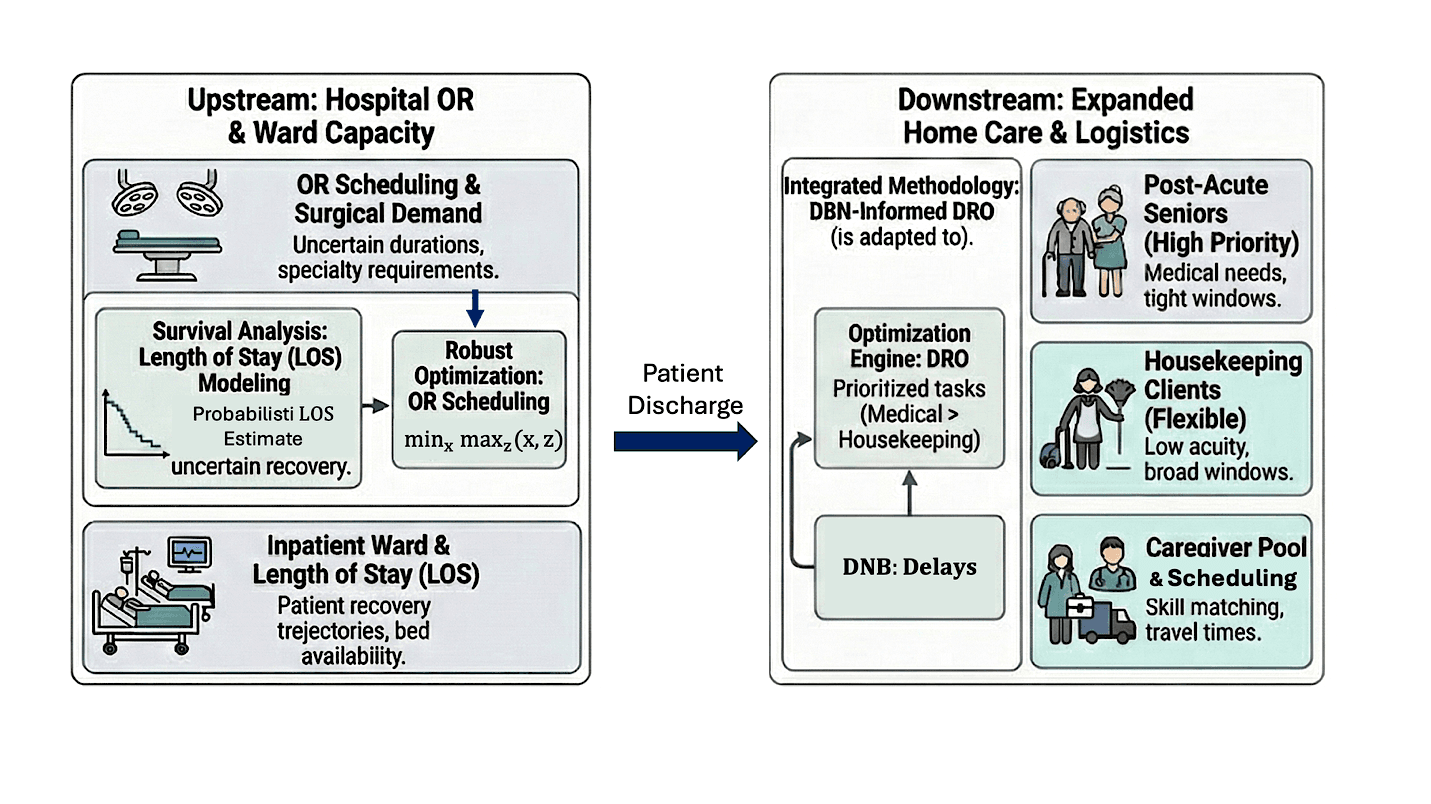
Integrated healthcare scheduling framework across the patient care pathway.* The upstream module models operating room (OR) scheduling and inpatient ward capacity under uncertainty in surgery duration and length of stay (LOS), using predictive models and robust optimization to coordinate surgical decisions and downstream bed availability under uncertainty. Patient discharge decisions generate demand for post-acute services in the downstream module, which captures home-care and related logistics. This module integrates long-term caregiver–client assignment and short-term assignment and scheduling decisions, accounting for time windows, travel times, service durations, breaks, and delay uncertainty propagation through a dynamic Bayesian network.